

On Dreaming in Stuart Little, The Great Gatsby, and The Wind in the Willows
Is it safe to re-imagine your life?

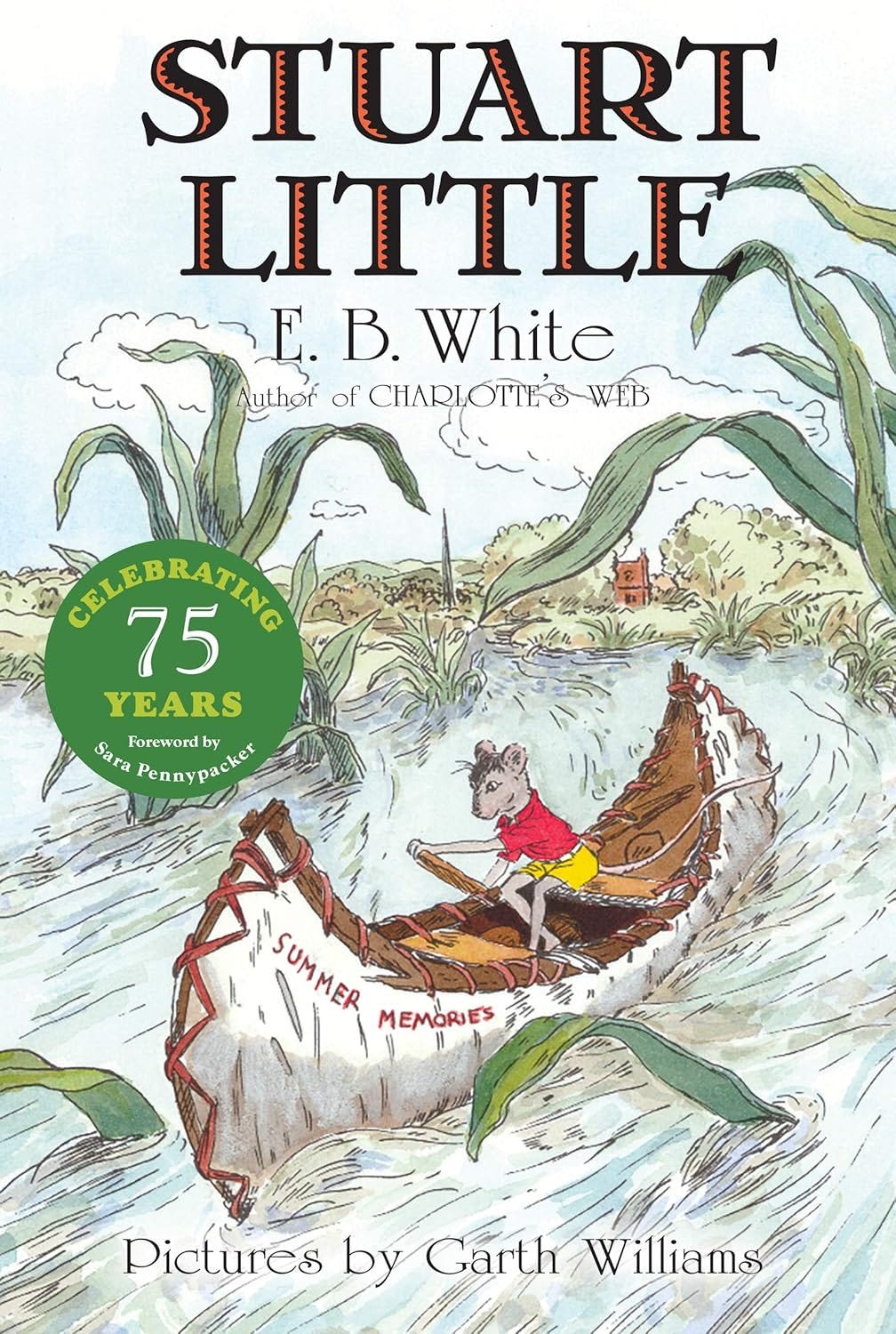
This year I fell in love with Stuart Little. It started when my brother-in-law read the book aloud to my son over the course of a weeks’ visit, and then gifted him a copy to take home.1 It continued when we got tired of reading it over and over and bought the audiobook on Audible (this one, it’s perfect). By the time my kid had it memorized, Stuart had earned my undying affection.
The power of Stuart Little lies with its protagonist. Stuart is an elemental character, as fully-formed as any other in fiction. His bluster, his integrity, his industriousness, his faint ridiculousness, his desperate need to be taken seriously—these are traits shared by some of the great characters in fiction and in our lives. Stuart leaps off the page with the same charisma as Jay Gatsby or Michael Scott or Mr. Toad, somehow one hundred percent believable, despite being, after all, a mouse born to human parents.
Chapters XIII-XIV of Stuart Little, Ames’ Crossing and An Evening on the River, act both as a microcosm of Stuart’s dreamer’s personality and a crucible through which his resolve must pass. These are the chapters that I’d like to compare both to The Great Gatsby and The Wind in the Willows. All three of these stories allow that dreaming better things for yourself has its power and its place; and all three stories warn against the dangers of re-imagining of your life against the pull of reality.
Stuart at a Crossroads
In the Ames’ Crossing episode of Chapters XIII and XIV, we watch Stuart get distracted from his noble quest by a fantasy, a hypothetical life. At the beginning of the episode, we find Stuart in the middle of his quest to find his one lost love, a bird named Margalo (Margalo fled the threat of a cat; Stuart is unaware of this). But Ames’ Crossing seduces him with visions of a different life. Here are Stuart’s first impressions of the town:
This was the most peaceful and beautiful spot he had found in all his travels. It seemed to him a place he would gladly spend the rest of his life in, if it weren’t that he might get homesick for the sights of New York and for his family, Mr. and Mrs. Frederick C. Little and George, and if it weren’t for the fact that something deep inside him made him want to find Margalo.
In other words, he would gladly spend the rest of his life here, if only it contained the things that he values most—which it doesn’t. No New York, no family, and most importantly, no Margalo.
Stuart already considers himself a romantic hero at the beginning of this episode. The problem, indeed, is not his personality, but whether or not he will adhere to reality. So when a shopkeeper mentions a girl he might like to meet (a tiny girl named Harriet Ames who not only is just Stuart’s size, but also “considered one of the best dressed girls in this town, too”), Stuart replies:
I’m not much of a society man these days. Too much on the move. I never stay long anywhere—I blow into a town and blow right out again, here today, gone tomorrow, a will o’ the wisp. The highways and byways are where you’ll find me, always looking for Margalo. Sometimes I feel that I’m quite near to her and that she’s just around the turn of the road. Other times I feel that I’ll never find her and never hear her voice again. Which reminds me, it’s time I was on my way.
Though Stuart applies his signature dramatic flair and his romantic self-image, we know that the heart of what he says here is true: His destiny is to look for Margalo. Finding her is the dearest dream of his heart.
But, like many of our best protagonists,2 Stuart gets caught in the pull of a hypothetical life. The next paragraph begins, “But Ames’ crossing seemed like the finest town he had ever known…his thoughts returning to the conversation he had had with the storekeeper. ‘Harriet Ames,’ he murmured.” We watch him begin to be caught. We watch him talk himself into this distraction. In the end, he completely loses himself in daydreams, not only asking Harriet on a date, but imagining every detail of how that date will go:
In imagination he lived every minute of their evening together. They would paddle to a large water-lily pad upstream, and he would invite Harriet to step out on the pad and sit awhile. Stuart planned to wear his swimming trunks under his clothes so that he could dive off the lily pad into the cool stream. He would swim the crawl stroke, up and down and all around the lily pad, while Harriet watched, admiring his ability as a swimmer (Stuart chewed the spruce gum very rapidly as he thought about this part of the episode.)
…As five o’clock drew near, Stuart grew more and more nervous…He couldn’t imagine what he would do if it should rain just as Harriet Ames showed up to go canoeing.
Stuart is not thinking about Harriet here. He is thinking about himself. He is thinking of the kind of person he wants to be: debonair, casual, impressive. He is thinking of an alternate life, one in which he wins the town’s heiress (by dint of his water-sport prowess) and stays in Ames’ Crossing forever. An impressive, untouchable hero.
But, poor Stuart: it turns out that he is not casually cool. When he discovers that his canoe has been wrecked, he cannot handle it. His conversation with Harriet at this point goes on for quite a while, but here is some of it:
Stuart was heartbroken. He did not know what to do.
…Harriet was for fixing the canoe up and going out on the river anyway, but Stuart couldn’t stand that idea.
“It’s no use,” he said bitterly, “It wouldn’t be the same.”
…“We could pretend we were fishing,” said Harriet, who didn’t realize that some people are fussy about boats.
“I don’t want to pretend I’m fishing,” cried Stuart, desperately, “Besides, look at that mud! Look at it!” He was screaming now.
Harriet is flexible, and tries to accommodate Stuart. But Stuart cannot be flexible, because his fantasy life is inflexible. When reality shatters his daydream, it turns out that what he wanted was not a date with Harriet, but to live a perfect life as a perfect self. When it turns out that the imaginary life is unattainable, he discovers that the alternative—taking Harriet on a different date, appearing as anything other than the swashbuckling figure he imagined—cannot be born. Harriet leaves him, “alone with his broken dreams and his damaged canoe.”
A Moment for Gatsby
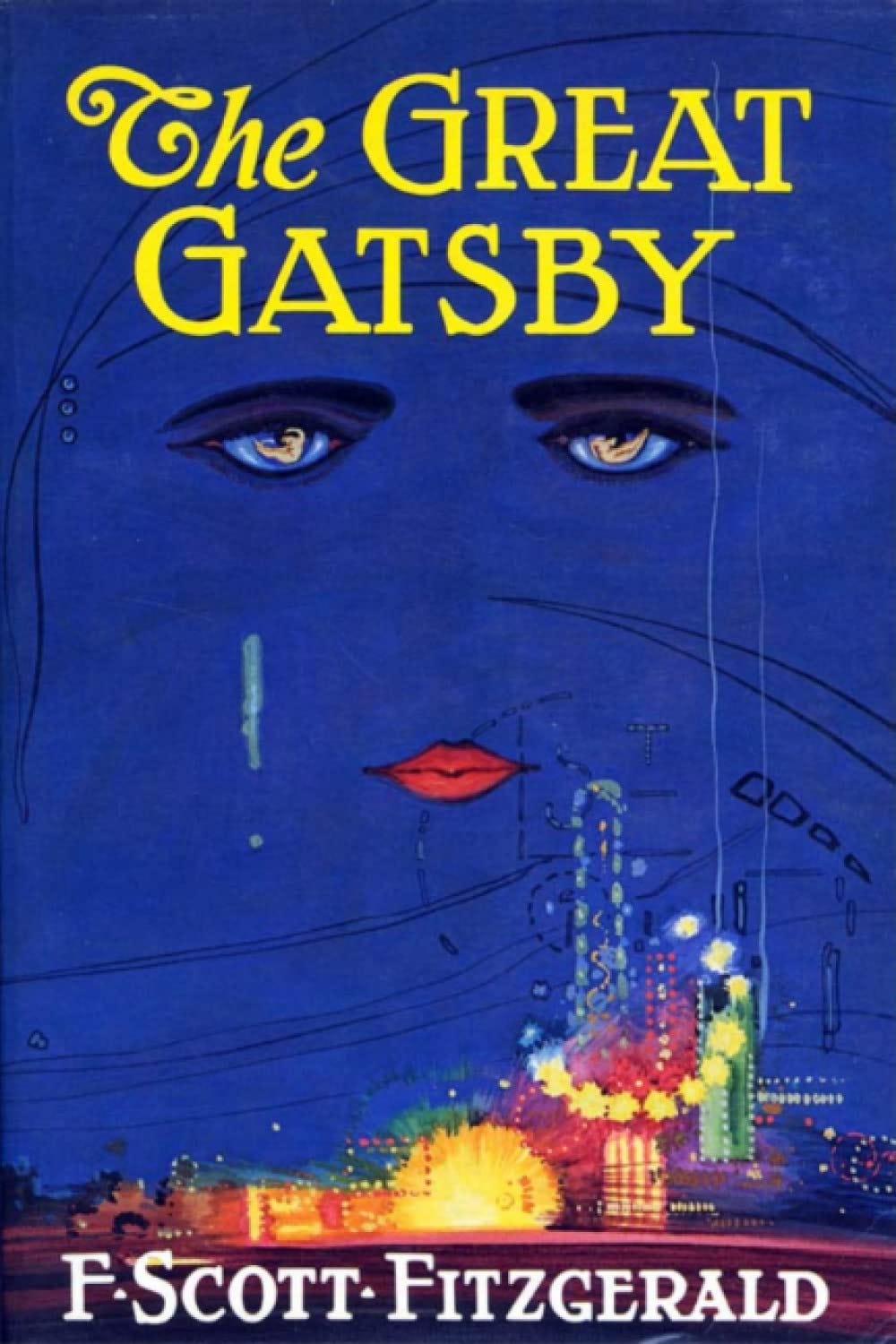
Let’s leave Stuart as Harriet did, for now, and talk about The Great Gatsby. Jay Gatsby is another marvelous dreamer—the marvelous dreamer. No one constructs a fantasy life like Gatsby, and no one crashes so spectacularly into the concrete wall of reality.
Until writing this essay, I had never noticed the epigraph at the beginning of The Great Gatsby:
Then wear the gold hat, if that will move her;
If you can bounce high, bounce for her too,
Till she cry “Lover, gold-hatted, high-bouncing lover,
I must have you!”
What an incredible quote. Perfect for Gatsby, and perfect for Stuart too, these few lines, with their ifs and tills, capture both the ridiculousness and the hope of the hopeless romantic. Ah yes, women want gold hats and bouncing. Ah yes, men want the desire of women. This is what both Gatsby and Stuart want: that their chosen object would recognize what they have valued in themselves (“gold-hatted, high-bouncing lover”) and desire it (“I must have you!”). When, in reality, it is the lover who must have the woman; and the lover who must have the hats and the bouncing too.
Gatsby’s identity is so consumed by his fantasy life that he cannot recover when it falls apart. In the climactic scene of the novel, when Gatsby and Tom finally have their confrontation in the city, Gatsby says to Daisy:
Just tell him the truth—that you never loved him—and it’s all wiped out forever.”
She looked at him blindly. “Why—how could I love him—possibly?”
“You never loved him.”
…”Oh, you want too much!”she cried to Gatsby. “I love you now—isn’t that enough? I can’t help what’s past.” She began to sob helplessly. “I did love him once—but I loved you too.”
Gatsby’s eyes opened and closed.
“You loved me too?” he repeated.
There is, it turns out, no way to “wipe it all out forever.” Daisy is not the woman of his imaginary realm; she loved him but she loved Tom too, and nothing Gatsby does can undo what has been done. He “wants too much.” In this moment, it becomes clear that his dream is actually impossible.
In trying to force reality into the shape his dream requires, Gatsby loses everything. The narrator writes, “only the dead dream fought on as the afternoon slipped away, trying to touch what was no longer tangible, struggling unhappily, undespairingly, toward that lost voice across the room.” Daisy is lost; the dream is dead; and yet Gatsby still struggles “undespairingly” on. He is no Stuart Little, to throw up his hands in defeat. He has no true story to return to, no Margalo to pursue into the sunrise. Without the dream of Daisy, and Daisy on his terms, Gatsby has nothing. It is no wonder he does not survive the novel.
The “Imperious Call” in The Wind in the Willows
So what—do we just give up on dreaming? Is imagining a new life for ourselves so dangerous? Should we forsake fantasy and devotion and single-minded purpose?
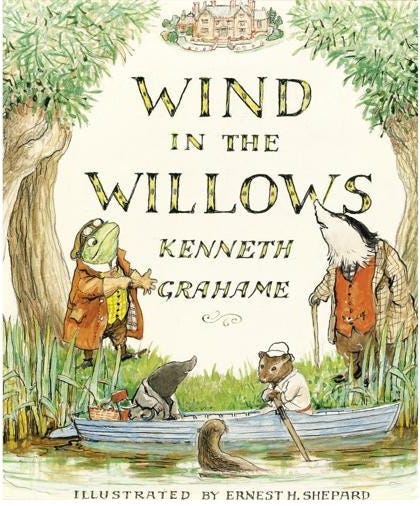
One of the best stories to take on these questions is The Wind in the Willows, which provides for both possibilities: 1) changing your whole life can open up new worlds of friendship and joy that would otherwise be beyond all imagining, and 2) changing your whole life can wreck everything that you hold dear and you should never, ever leave. Uh oh.
The first example in the book of changing one’s whole life, of course, is Mole. He leaves his home in the very first paragraph of the book:
Spring was moving in the air above and in the earth below and around him, penetrating even his dark and lowly little house with its spirit of divine discontent and longing. It was small wonder, then, that he suddenly flung down his brush on the floor, said ‘Bother!’ and ‘O blow!’ and also ‘Hang spring-cleaning! and bolted out of the house without even waiting to put on his coat. Something above was calling him imperiously
…By the side of the river he trotted as one trots, when very small, by the side of a man who holds one spellbound by exciting stories; and when tired at last, he sat on the bank, while the river still chattered on to him, a babbling procession of the best stories in the world, sent from the heart of the earth to be told at last to the insatiable sea.
Thus Mole, within three pages, leaves his home and finds the riverbank, where he will remain a happy citizen for the rest of the story, and, as far as we know, the rest of his life. There is a degree of hypnosis going on here, or at least an outside force acting on Mole: Spring has a “spirit of divine discontent and longing”; something “call[s] him imperiously”; he is like one “spellbound by exciting stories.” But this move is an overwhelmingly positive one for Mole. He becomes fast friends with Ratty on day one, and is thus welcomed in to an entire community of animals who look out for one another in and around the thriving, chattering river.
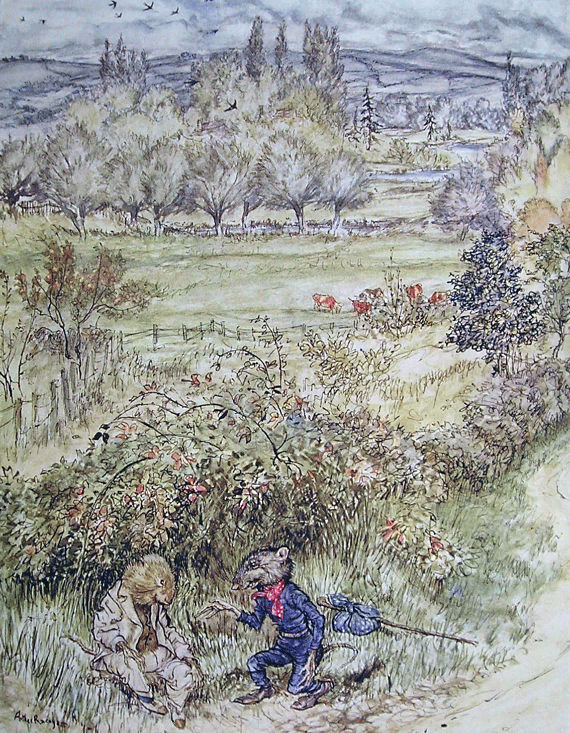
Ratty, in his turn, has a brush with leaving home. Chapter 9, Wayfarers All, begins, “The Water Rat was restless, and he did not exactly know why.” All the birds are preparing to fly South, to move on, and Rat, though he is “a self-sufficing sort of animal, rooted to the land, and, whoever went, he stayed; still, he could not help noticing what was in the air, and feeling some of its influence in his bones.” This recalls Stuart, who thinks Ames’ Crossing is the kind of place he could stay forever—if only staying there did not contradict the core of his being. Rat is a staying, resting sort of animal—who suddenly feels restless.
In this mood of restlessness, Ratty meets the Seafaring Rat. This visitor describes Ratty’s riverbank, and concludes, “It is a goodly life you lead, friend; no doubt the best in the world, if only you are strong enough to lead it!” This is our first hint that Ratty is in for a trial. The Seafaring Rat continues, “here I am, footsore and hungry, tramping away from it, tramping southward, following the old call, back to the old life, the life which is mine and which will not let me go.” The language here recalls the “imperious call” that drew Mole from his home. This visiting rat, like Mole, has a call on his life. The question lingers—does Ratty?
Though the Seafaring Rat begins their acquaintance by validating Ratty’s choice of life, by the end of their time together he does what he can to upend it completely. Over a meal, the visitor tells Ratty tales from his adventures, and Ratty is “Spellbound and quivering with excitement” (like Mole, who was also “spellbound” by the story-telling river). The storytelling goes on and on until at last the visitor makes his pitch:
And you, you will come too, young brother; for the days pass, and never return, and the South still waits for you. Take the Adventure, heed the call, now ere the irrevocable moment passes! …Then some day, some day long hence, jog home here if you will, when the cup has been drained and the play has been played, and sit down by your quiet river with a store of goodly memories for company.
This is a powerful argument: Don’t miss your chance. What is home to a grand adventure?
If “hypnotized” was too strong a word for Mole at the beginning of his adventure, it certainly seems appropriate here: Rat is hypnotized by the visitor’s words, and “mechanically” begins to pack up to leave his life. Ironically, it is Mole that stops him. The text says,
“[Ratty] pressed resolutely forward, still without haste, but with dogged fixity of purpose; but the Mole, now thoroughly alarmed, placed himself in front of him, and looking into his eyes saw that they were glazed and set and turned a streaked and shifting grey—not his friend’s eyes, but the eyes of some other animal! Grappling with him strongly he dragged him inside, threw him down, and held him…he sat collapsed and shrunken into himself, his body shaken by a violent shivering, passing in time into an hysterical fit of dry sobbing.”
Certainly there is a strange outside control at play here. Ratty is not himself. He has been overcome by something like an “imperious call,” and to the degree that he has transformed into a different animal altogether. The language here clearly indicates that something sinister has happened to Rat, and that Mole is a good friend to bring him back to himself—if the eyes are the windows to the soul, then Rat’s soul has been glazed over and altered beyond recognition. That can’t be good. And yet it always struck me as odd that Mole, who heeded his own call and left his own home, should be the one to prevent Ratty from doing the same. Who’s to say there wasn’t a rich, full life awaiting Ratty at sea, like the one that awaited Mole on the riverbank?
Rat’s sobbing fit here is not the only one in the book. In chapter five, Dulce Domum, Mole, too, is overcome by sobs, and for the inverse reason: He wants to return to his home. He is on a walk with Rat when “one of these mysterious fairy calls from out of the void [] suddenly reached Mole in the darkness.” More language of a “call”, and here it is Mole’s previous home calling to tell him it is close by. The text goes on to say, “The call was clear, the summons was plain.” But Rat does not listen when Mole asks him to stop, and Mole’s fit of sobs begins:
[He] tried to control himself, for he felt surely it was coming. The sob he had fought with so long refused to be beaten. Up and up, it forced its way to the air, and then another, and another, and others thick and fast; till poor Mole at last gave up the struggle, and cried freely and helplessly and openly, now that he knew it was all over and he had lost what he could hardly be said to have found.
This is the price of ignoring the call—both Ratty and Mole pay in tears. And yet Mole, in both the call to leave his home and to return, seems still to be himself. It’s as if the call comes from within and without him. Mole is not “some other animal,” like the hypnotized Rat had been; he is himself, all the way at the edges of himself, called by grief and joy further into the experience of his own little life.
The book says that there is a price to pay, both for following your dreams, and for ignoring them. Mole leaves his home without a thought, and it turns out, that wasn’t nothing. His home is still there, missing him. It still has a hold on him, because it was his.3 Just so, Rat’s home would have retained its hold on him even if he had left it, perhaps with even greater intensity because of the kind of creature Rat is: “a self-sufficing sort of animal, rooted to the land, and, whoever went, he stayed.” To leave, for Rat, would have betrayed some essential part of himself. And yet he never does take that southern Adventure.
The Wind in the Willows leaves us with an essential unresolvedness about the two situations. The chapter about Mole’s homecoming ends thus:
“He did not at all want to abandon the new life and its splendid spaces, to turn his back on sun and air and all they offered him and creep home and stay there; the upper world was all too strong, it called to him still, even down there, and he knew he must return to the larger stage. But it was good to think he had this to come back to, this place which was all his own, these things which were so glad to see him again and could always be counted upon for the same simple welcome.”
This squares with the Seafaring Rat’s vision for the return home: “Then some day, some day long hence, jog home here if you will, when the cup has been drained and the play has been played, and sit down by your quiet river with a store of goodly memories for company.” It seems the wanderer is correct, that home will wait for you. But the role of Home in your life must change when you leave it. It did for Mole. Graham suggests that in leaving home, you spoil it for yourself by opening up new vistas. After all, it isn’t home in the same way anymore; Mole wants to leave again. But if we are guided by the “spirit of divine discontent,” if the call is true, perhaps that doesn’t have to be completely heartbreaking.
This is fundamentally sad, to me. But it rings true. It would be tidier if Kenneth Graham had written it differently—but life isn’t tidy. Neither is following a call. How do we know if the call is good or bad, making us more ourselves or less so? And even in pursuing the best of calls, the worthiest of dreams, the hopes most true to our essential selves—there is loss. You cannot have it all. But you can hope to have one life that is good.
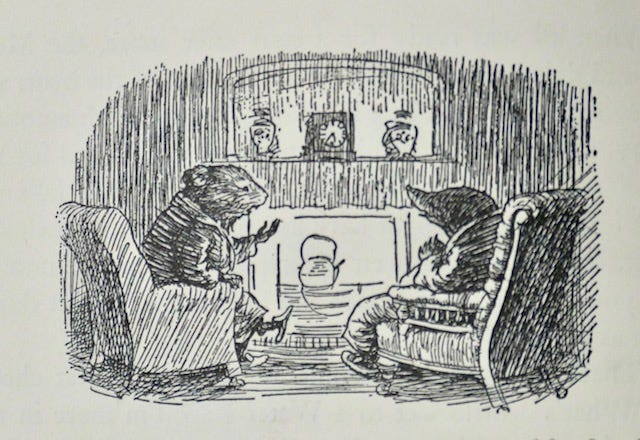
All of these dreamers. Stuart and Gatsby and Ratty and Mole. Everyone wants one good life, and they pursue it with varying degrees of success. I think these stories tell us that there is no formula for the healthy pursuit of a dream. There is only knowing yourself, knowing your friends, and striving for discernment. Am I trying to warp reality to my will? Or is this dream I’m pursuing also true?
Stuart’s call—the true one, the one that accords with reality—is the pursuit of Margalo. In the final chapter of the book, he leaves Ames’ Crossing and his fantasy life. His crossroads behind him, “Stuart never let a bird pass without looking to see if it was Margalo.”
When the book was published, children everywhere were appalled that Stuart does not find Margalo within its pages. But weathering Ames’s Crossing sets Stuart up for his destiny. When we face the demolition of our daydreams, we are freed up to see the true story that can unfold in our lives. These true stories are not less wonderful. Stuart’s true story is one of chivalric devotion. Mole and Ratty’s is a life rich with story and community and the mysterious call of the divine. Gatsby’s—it hurts to wonder what that dreamer’s life might have been, if he had only seen clearly.
Maybe these stories can help us to dream better. Or maybe they can simply encourage us that this is hard, deciding what to do with our “one wild and precious life.”4 This is why I like the ending of Stuart Little, though it feels abrupt, though the story is unresolved. It encourages me, as I look into the wide unknown of my future, to read these final lines: “As he peered ahead into the great land that stretched before him, the way seemed long. But the sky was bright, and he somehow felt that he was headed in the right direction.”
This article contains affiliate links. This means that if you purchase a book linked here, I will receive a small commission, at no extra cost to you. Thanks for supporting The Better Reader!
For those paying attention to Andrews Family Dynamics, that’s two Uncle Henry shout-outs in two weeks ;)
Aeneas and Dido, Gatsby in pursuit of Daisy, Romeo and Juliet…
This reminds me of Saint Exupéry’s quote in The Little Prince: “You are responsible forever for what you have tamed.”
“The Summer Day,” Mary Oliver
So good. The Great Gatsby is a favorite. SO much to unpack there… ! https://millerandybeth.substack.com/p/summering-and-a-story-autopsy
What a fun read! I enjoyed this conversation that resulted from the three books, particularly the idea of Stuart and Gatsby both in love with the idea of themselves, forcing the objects of their affection into fragile, static roles. I just read The Red House Mystery by Milne and was curious if you have read it.